Winter Floor Care: How to Protect Your Floors in Wilmington
By Sean Henry, Owner of Floor Concepts · Updated November 2, 2026
If you've ever spotted a white, chalky film inside your front door in February, you've met road salt. It rides in on boots, dries on your floor, and slowly dulls the finish.
Quick answer: Winter floor care comes down to three habits. Stop salt and slush at the door. Clean ice-melt residue with the right cleaner for your floor. Keep your indoor humidity between 30% and 50%. Do those three things, and most floors come through a Wilmington winter looking the way they did in the fall.
At Floor Concepts, we've been helping Wilmington homeowners choose, install, and care for their floors since 1982. We've seen what one season of salt and slush can do to an entryway, and we've refinished plenty of hardwood that took the hit.
The good news is that winter damage is almost always preventable. Here's what winter does to your floors and what to do about it, floor by floor.
Winter attacks floors in four ways:
Each one has a simple fix.
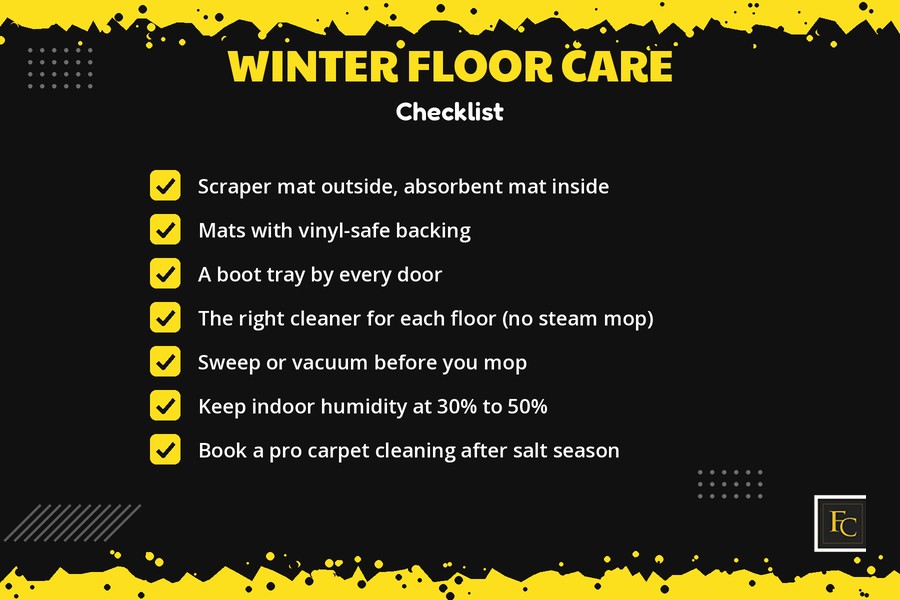
The cheapest floor protection you'll ever buy is a good doormat. Actually, two.

Shake out or vacuum your mats often. A soaked mat is just a puddle with a border.
Tip: Check the backing before you buy. Many vinyl flooring manufacturers warn that rubber- or latex-backed mats can permanently discolor vinyl. Look for mats labeled safe for vinyl floors.
Dry first, then use a cleaner made for your type of floor. If you mop salt with plain water, you just spread it around.
Skip steam mops, vinegar on hardwood, oil soaps, and wax-based products. They can damage the finish, and some of them can void your flooring warranty.
We carry Bona and Karndean cleaners in our showroom if you'd like to pick up the right one.
Dry winter air makes wood give up moisture and shrink, which opens small gaps between boards. In most homes, that's normal, and the gaps close again as humidity returns in spring.
The National Wood Flooring Association recommends keeping indoor humidity between 30% and 50% year-round. You can read their explanation in Hardwood Floors magazine's guide to seasonal gaps. Forced-air heat can push your home well below that range on cold days.
To keep gaps small:
Wider boards show wider gaps. That's simple physics, not a defect.
When to call us: gaps that don't close by summer, boards that cup or crown, or cracks along the boards. Those can point to a moisture problem worth checking.
Vacuum entry areas more often in winter, and treat salt stains gently.
LVP and tile handle winter better than most floors, but they aren't invincible.
LVP surfaces are waterproof, but standing water can work its way into the edges and under the planks. Wipe up puddles by the door instead of letting them sit.
Tile itself shrugs off water. Grout is the weak spot. Traditional cement-based grout is porous and usually needs sealing to resist salt and stains, while some products, like many epoxy grouts, don't. If you're not sure what you have, ask your installer.
If you're planning a project, here's how the main floor types handle cold, wet months:
For more on durable choices, see our guide to the best flooring options for homes with kids and pets.
You don't need to rip out a hardwood foyer just because it snows. Many older Wilmington homes have had hardwood at the front door for decades. With good mats and quick cleanup, it does just fine.
And if winter has already left its mark, it's usually not too late. Light salt damage and dull, worn finishes can often be fixed with hardwood floor refinishing instead of replacement.
Salt is a winter visitor. Damage doesn't have to be.
A good mat, the right cleaner, and a humidifier do most of the work.
Whether or not you're our customer, we're happy to help. Stop by our showroom at 4315 Kirkwood Highway to pick up the right cleaner or ask a question. If your floors are already showing winter wear, schedule a free estimate and we'll tell you honestly whether they need a cleaning, a refinish, or nothing at all.
Yes, in most homes. Dry heating-season air makes wood shrink a little, and the gaps usually close by late spring. Keeping humidity between 30% and 50% keeps them small. If gaps don't close by summer, give us a call.
Sweep or vacuum first, then use a pH-neutral hardwood cleaner on a microfiber mop. Skip vinegar and plain water, which can dull the finish. If the finish is already worn through, refinishing may be the fix.
We don't recommend it. Steam can damage finishes and push moisture into seams, and many manufacturers say it can void your warranty. A damp microfiber mop with the right cleaner is safer.
Yes, and it's one of the best things you can do in winter. Just choose one labeled safe for vinyl, since some rubber- and latex-backed mats can discolor vinyl floors.
Floor Concepts has served Wilmington, Greenville, Hockessin, Newark, Middletown, Bear, Avondale, New Castle, Kennett Square, Landenberg, Smyrna, Dover, and the surrounding areas for over 40 years. Every installation we do is backed by our Lifetime Installation Warranty.
Floor Concepts
4315 Kirkwood Highway
Wilmington, DE 19808
(302) 279-5940
Ready for Real Numbers?
Get a price range for your rooms in two minutes, or compare samples at our Kirkwood Highway showroom.
Thank you for contacting Carpet One Floor & Home. Your local flooring expert will reach out to you regarding your inquiry.