Executive Summary: If you’ve seen luxury vinyl plank (LVP) flooring advertised for $1.99 per square foot, you may be wondering if it’s too good to be true. The truth is, sometimes it’s a great deal, and other times it’s not. A low price doesn’t always mean low quality. For example, we have had opportunities to purchase close-out inventory from one of our manufacturers. This allows us to offer a product that usually costs a lot more at a promotional price. This has helped some of our customers save hundreds, even thousands of dollars.
At Floor Concepts, we have installed over 3,000 LVP floors in the Wilmington area. Our hands-on experience has taught us that some cheaper options save money by using thinner wear layers, weaker locking systems, or older product lines, which can cause issues down the road. In this guide, we’ll show you how to spot the difference so you can decide if a $1.99 floor is a smart buy or not.
Walk into almost any flooring store, and you’ll eventually see it: Luxury Vinyl Plank – Starting at $1.99 per square foot.
It’s one of the most common questions we hear in our showroom: “Is that flooring actually any good?”
The honest answer is that sometimes it absolutely is. At Floor Concepts, we sometimes have promotions where we offer high-quality LVP at about that price. These deals aren’t available all the time, but when they are, homeowners can get great value.
But not every $1.99 floor is created equal. Some floors are discounted because there’s extra stock or a seasonal sale. Others are cheap because they’re made as low-cost options from the start. It’s much more important to know the difference than to just look at the price.
If you're trying to understand what a complete LVP project costs—including installation—be sure to read our How Much Does Luxury Vinyl Plank Flooring Cost in Wilmington, DE? (2026 Guide).
At first glance, two vinyl planks may look almost identical. They might even have similar colors and textures. The difference is often what’s underneath the surface.
Better LVP usually has a thicker wear layer, a stronger core, better locking systems, more realistic textures, and longer warranties. These features cost more to make, but they help the floor last longer. That’s why we suggest looking at more than just the price. A sample piece of flooring doesn’t show you everything you need to know.
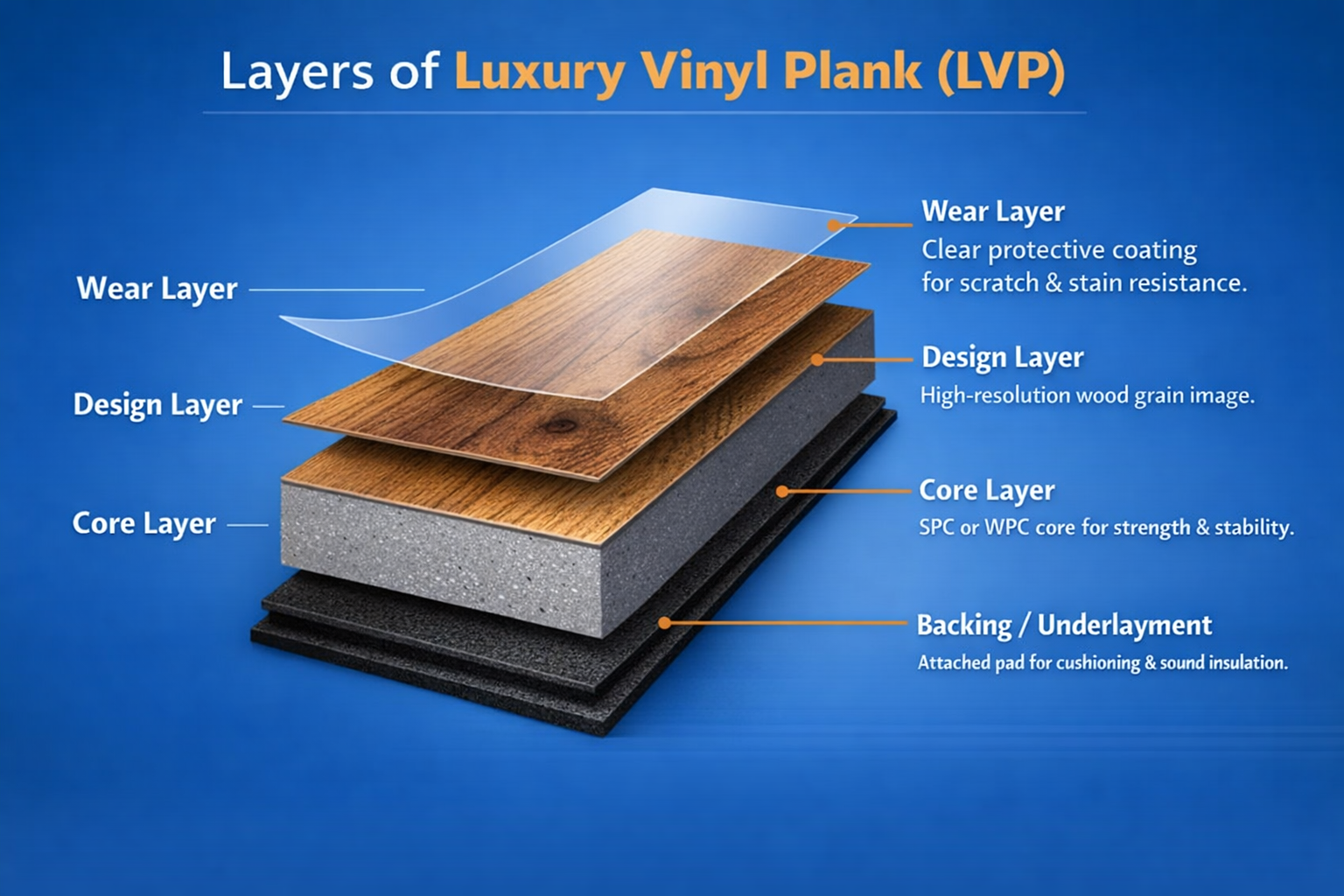
Price is only one part of the equation. Before deciding whether a $1.99 floor is a bargain, look at the features that affect how the floor will perform over time.
| Feature | What We Recommend for Most Homes |
|---|---|
| Wear Layer | 20 mil or greater |
| Overall Thickness | Around 6 mm or thicker |
| Locking System | Look for established systems such as Unilin®, Välinge®, or i4F® |
| Warranty | A strong residential manufacturer's warranty |
Wear Layer: For most homeowners, we recommend looking for a wear layer of at least 20 mils, especially in busy homes with kids, pets, or heavy foot traffic. Lower wear layers can work well in bedrooms, rental properties, or other light-use areas, but they may show wear sooner in high-traffic spaces.
Overall Thickness: Thickness isn't everything, but it does matter. We generally recommend a floor that's around 6 mm thick or greater. A thicker plank often feels more solid underfoot and can help hide minor imperfections in the subfloor.
Locking System: Not all locking systems are created equal. We recommend choosing products that use established locking technologies such as Unilin®, Välinge®, or i4F®. These systems have been proven through years of real-world use and are often easier to install correctly than generic locking designs.
From our experience, our installers appreciate working with well-designed locking systems because they tend to fit together more consistently and are less likely to be damaged during installation when used correctly. That doesn't mean every other locking system is bad, but it is one of the details we pay attention to when recommending products.
If the packaging simply says "click" without identifying the locking technology, that's a good reason to ask your flooring retailer what locking system it uses and how it has performed over time.
Warranty: Finally, compare the manufacturer's warranty. While a longer warranty doesn't guarantee a better floor, it can provide additional confidence in the product you're considering. Learn more about warranties in 5 Ways You Can Accidentally Void Your Flooring Manufacturer's Warranty.
A common mistake is thinking that all floating LVP floors are installed the same way. That’s simply not true. Some are very forgiving for DIY installers. Others require much more precision.
Different brands use different locking systems. Some use angle-tap or angle-angle designs, while others use drop-and-lock or their own unique connections. Does your installer know the difference and how each one fits together a little differently?
If the planks aren’t locked together properly during installation, gaps can show up later. Even worse, the locking mechanism can get damaged during installation. If that edge breaks, the plank needs to be replaced. Sometimes, we see DIY installers use damaged planks because they don’t want to waste material. This almost always causes problems later on.
If you plan to install LVP yourself, be sure to read the manufacturer’s instructions before you start. Pay attention to how the locking system works, how much force to use, the recommended expansion gaps, and the right way to install the last row and work around doorways. Carefully following these instructions can mean the difference between a floor that lasts for years and one that has problems after just a few months.
One question many buyers never think to ask is: “Why is this floor on sale?”
Sometimes the answer is great news. A retailer may have purchased extra inventory, negotiated a special buy from a manufacturer, or be running a seasonal promotion.
Other times, the flooring has been discontinued. That doesn’t always mean you should avoid it, but it’s something to know before you decide. If a product is discontinued, ask if matching transition pieces are still available. If you need to fix part of the floor in a few years, will you be able to get replacement planks?
Even if you find another box with the same color name later, the manufacturer may have changed the locking system. We’ve seen cases where new planks with the same color wouldn’t fit with the older floor because the product was updated. These are important things to ask before choosing a discontinued floor as your best deal.
Sometimes it absolutely does. If you buy a quality product during a real promotion, you could be getting one of the best deals in flooring. Other times, the cheapest flooring ends up costing more in the long run because it wears out faster, is harder to install, or makes repairs tougher later.
The goal isn’t just to find the cheapest floor. What matters is understanding why the floor is inexpensive.
Ask about the wear layer and the locking system. Find out if it’s a discontinued product and if matching trim pieces are still available. If you plan to install it yourself, be sure you understand the manufacturer’s instructions before you start. These questions will teach you more about a floor’s value than the price tag alone ever could.
At Floor Concepts, we’d rather help you understand the differences between products than just sell you the cheapest option. Sometimes the $1.99 special is the best value. Other times, paying a bit more at the start can save you money and hassle in the long run.
Start by using our Pricing Calculator to get a realistic budget for your project. Then, when you're ready, schedule an in-home estimate so we can help you compare products that fit both your home and your budget.
FAQ 1: Can I use $1.99 LVP in a bathroom or laundry room?
Answer: While almost all luxury vinyl plank is 100% waterproof, budget-friendly LVP is often thinner (under 5mm). In a bathroom or laundry room, a thin plank is less forgiving over the slight subfloor dips around plumbing fixtures and drains. Furthermore, budget lines may lack an attached underlayment cushion, meaning moisture from concrete subfloors can get trapped more easily. If you use a budget floor in a wet area, ensuring flawless subfloor preparation and using a high-quality moisture barrier is absolutely critical.
FAQ 2: Does the $1.99 price tag usually include the underlayment padding?
Answer: Rarely. Premium LVP typically comes with an acoustic pad already glued to the back of each plank. Budget-priced flooring often strips this feature out to keep costs low. When shopping, always look at the back of the sample. If it is bare vinyl, you will need to purchase and install a separate underlayment roll, which can add an unexpected $0.40 to $0.80 per square foot to your actual material costs.
FAQ 3: How many extra boxes should I buy if I’m purchasing a close-out or discontinued deal?
Answer: Normally, we recommend ordering 10% extra for cutting waste. However, if you are buying a $1.99 discontinued or close-out style, we strongly recommend buying 15% to 20% extra. Because the manufacturer has stopped producing that specific dye-lot and locking profile, you cannot simply order another box down the road if a plank gets damaged by a heavy drop or an appliance leak. Having a couple of pristine "attic boxes" safely stored away is your only insurance policy.
FAQ 4: Will a cheaper $1.99 floor look more repetitive across a large room?
Answer: It often does. The cost of a vinyl plank is heavily tied to its design technology. Budget floors use smaller "print patterns," meaning the wood-grain pattern might repeat every 4 or 5 planks. Premium floors use massive print cylinders that create 10 to 20 unique planks before a repeat occurs. If you install a budget floor in a massive, wide-open space, you run the risk of a "cookie-cutter" look where identical knots and wood grains sit right next to each other. Careful board blending during installation is required to hide this.
FAQ 5: If I buy the material online or at a liquidator for $1.99, will local pros still install it?
Answer: While some independent subcontractors take "labor-only" jobs, Floor Concepts will not install outside materials. Because we provide our clients with a 100% lifetime installation warranty, we only install high-quality products that we sell and completely stand behind. When materials are sourced from online discount liquidators, there is no way to verify the manufacturer, material source, or structural integrity of the locking mechanisms. To protect our installers' time and ensure your home gets a flawless, warrantied finish, we exclusively install materials curated directly through our showroom.
Thank you for contacting Carpet One Floor & Home. Your local flooring expert will reach out to you regarding your inquiry.